What happens when you apply the same complete marketing infrastructure to brokerages in Montana, Oklahoma, and Florida? Here's what we learned.
A website isn't a marketing strategy.
It's one piece of infrastructure. And for most land brokers, it's the only piece they have.
That's the problem.
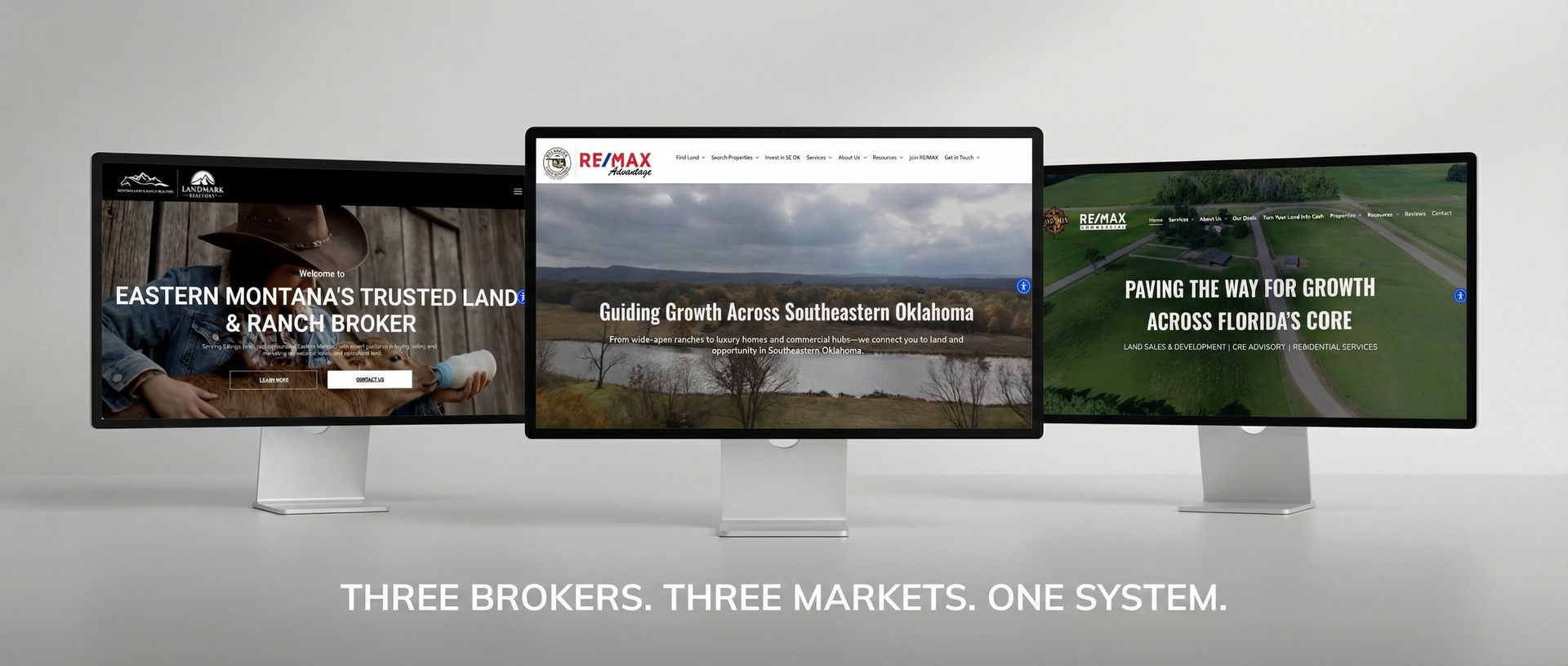
Over the past year, we built complete marketing ecosystems for three land brokers in three very different markets. Same system. Different execution. All converting.
This isn't theory. These are live sites you can visit right now:
- Erik Erickson — Montana Land and Ranch (mtlandandranch.com)
- Rod Canterbury, ALC — Oklahoma Land Division (oklahomalanddivision.com)
- David Bryant, CCIM — The Land Man (thelandman.co)
Montana. Oklahoma. Florida.
Different landscapes. Different clientele. Different regulatory environments. But the same underlying infrastructure that turns a website into a lead-generating machine.
Here's what we built for each — and why it works.
The Foundation: What Every Land Broker Actually Needs
Before we dive into specifics, let's establish what "complete marketing infrastructure" actually means. It's not a checklist of nice-to-haves. It's an integrated system where each piece supports the others.
The seven components:
- Authority Positioning — E-books, guides, published content that establishes expertise before the first conversation
- Visual Credibility — Professional video that builds trust faster than text ever could
- Lead Capture Ecosystem — Multiple entry points for prospects at different stages of readiness
- Service Architecture — Clear, organized presentation of what you offer and who you serve
- Resource Value — Tools and information that make your website worth bookmarking
- Content Engine — Blog, social, YouTube presence that compounds visibility over time
- Brand Consistency — Unified visual identity across every touchpoint
When these seven elements work together, your marketing compounds. Each piece feeds the others. Visitors become leads. Leads become clients. Clients become referral sources.
Now let's see how this played out across three different brokerages.
Erik Erickson: Montana Land and Ranch
The Broker: Erik is a rancher, veteran, and land broker based in Joliet, Montana — just outside Billings. He serves Eastern Montana, helping buyers and sellers navigate ranch land, recreational property, and agricultural transactions.
The Challenge: Erik had deep local expertise and a genuine connection to the land he sells. But his online presence didn't reflect that. He needed a platform that communicated his credibility to buyers who might be researching from anywhere in the country.
What We Built:
Homepage Video: A cinematic brand piece showing the Big Sky country Erik serves. Within three seconds of landing on the site, visitors see sweeping Montana landscapes and understand this isn't a part-time hobby — it's a legacy.
Dual E-Book Lead Magnets:
- "The No B.S. Guide to Buying Land in Montana" — for buyers doing their research
- "The Legacy Seller's Guide" — for landowners considering selling property that's been in their family for generations
Both are available on Amazon (establishing credibility) and as free downloads on the website (capturing leads). The psychology is simple: give away genuine expertise, build trust before the call, and let the content pre-sell your services.
Resource Hub: This is where the site becomes indispensable. Erik's resources section includes:
- GIS maps and property boundary tools
- Montana hunting access and landowner programs
- Water rights query systems (critical for ranch land)
- Mineral rights and geologic data
- 1031 exchange resources and tools
These aren't random links. They're the exact tools that serious land buyers and ranchers use repeatedly. Every return visit reinforces Erik's brand. Every bookmark is a future client.
Blog Content: Articles like "Why You Shouldn't Trust Just Any Real Estate Agent with Ranch Land" and "What You Need to Know Before Drilling a Well in Montana" demonstrate expertise while capturing long-tail search traffic.
YouTube Presence: @BillingsMTRealEstate features property tours, market insights, and Montana lifestyle content — building a searchable library of credibility.
Rod Canterbury: Oklahoma Land Division
The Broker: Rod is a lifelong rancher with an ALC (Accredited Land Consultant) designation — an elite credential held by roughly 1,200 professionals worldwide. He's backed by the RE/MAX network and serves Southeastern Oklahoma from his base in Eufaula.
The Challenge: Rod had the credentials and the network, but his digital presence wasn't capturing the full scope of what he offered. He needed a platform that could attract everyone from local landowners to out-of-state investors to commercial developers.
What We Built:
Homepage Video: Rod's video communicates two things simultaneously: deep local roots (he's a lifelong rancher who knows this land) and global reach (RE/MAX network, international connections). That combination is rare, and the video makes it tangible within seconds.
Triple E-Book Strategy:
- "Legacy to Liquidity" — for landowners ready to convert family land into cash
- "Oklahoma Dirt" — a comprehensive guide to land investment in the state
- "Oklahoma's Data Center Opportunity" — a white paper positioning Southeastern Oklahoma as the next frontier for data center development (this attracts an entirely different buyer profile)
The data center white paper is worth noting. It's not a generic guide — it's a strategic piece of content designed to attract commercial developers and position Rod as the expert in a specific emerging opportunity. That's targeted authority positioning.
Resource Hub: Oklahoma-specific tools including:
- Oklahoma Land Access Program links
- State business incentives and relocation resources
- New Markets Tax Credit information
- Wildlife Conservation department resources
Multi-Platform Lead Capture: The site includes distinct pathways for:
- Farm & ranch sellers
- Recreational land buyers
- Commercial developers
- International investors
- Off-market deal seekers
Each pathway captures different information and triggers different follow-up sequences. A recreational buyer and a commercial developer have nothing in common except that they both might contact Rod — so why would you put them through the same form?
YouTube Presence: @oklahomalandforsale provides land investment education and property features, building searchable content that works 24/7.
David Bryant: The Land Man (Central Florida)
The Broker: David holds the CCIM designation (Certified Commercial Investment Member) and serves Central Florida's I-4 corridor — Marion, Sumter, Polk, and Lake Counties. This is one of the fastest-growing regions in the country, and David specializes in development sites, commercial properties, and land sales.
The Challenge: David's market is different from Montana or Oklahoma. Central Florida is experiencing explosive growth, attracting developers, investors, and corporations from across the country and internationally. He needed a platform that could speak to sophisticated commercial buyers while also serving local landowners.
What We Built:
Homepage Video: David's video positions him as THE land authority in Central Florida. The messaging is clear: if you're looking to buy, sell, or develop land in this region, this is who you call.
Strategic Lead Magnets:
- "The Land Man's Guide to Buying, Selling & Maximizing Your Land's Potential" — comprehensive e-book for landowners
- "2026 Central Florida Market Outlook Report" — data-driven market analysis for investors and developers
The market outlook report deserves attention. It's not a sales piece — it's genuinely useful market intelligence that positions David as the expert who understands where this market is heading. Developers and investors download this because they need the data. And now David has their contact information and has established his expertise before any conversation.
Resource Hub: Florida-specific tools including:
- Greenbelt agricultural tax assessment guides (county by county)
- EQIP and Conservation Reserve Program information
- Delaware Statutory Trust (DST) resources for 1031 exchanges
- Preferred lender directory
- EB-5 investor program information (for international buyers)
The EB-5 information is strategic. Central Florida attracts significant international investment, and having resources for foreign buyers signals that David operates at that level.
Service Architecture: Clear separation between:
- Commercial brokerage services
- Land sales and development
- Residential services
- Property management
Each service has its own pathway, its own messaging, and its own lead capture. A developer looking for a 50-acre site and a family looking for a home with acreage are both served — but through different doors.
The Pattern: What All Three Have in Common
Different states. Different markets. Different broker personalities. But the same underlying infrastructure:
Component Montana Oklahoma Florida
Homepage Video ✓ ✓ ✓
E-Book Lead Magnets 2 guides 3 guides + white paper 2 guides + market report
Resource Hub GIS, water rights, hunting, minerals Land access, incentives, wildlife Tax assessment, DSTs, EB-5
Multiple Lead Capture Points ✓ ✓ ✓
YouTube Presence ✓ ✓ ✓
Blog Content Strategy ✓ ✓ ✓
Consistent Brand Identity ✓ ✓ ✓
The specific content is different because each market is different. But the system is the same.
And here's what matters: a system can be repeated.
Why This Approach Works
1. Authority is established before the phone rings.
By the time someone calls Erik, Rod, or David, they've likely downloaded an e-book, watched a video, and explored the resources. They're not calling to evaluate — they're calling because they've already decided this is the expert they want to work with.
2. Multiple entry points capture prospects at every stage.
A landowner who's three years away from selling isn't going to fill out a consultation request. But they might download "The Legacy Seller's Guide." Now they're in the ecosystem, receiving value, building familiarity. When they're ready, there's no question who they'll call.
3. Resource hubs create return visits.
A one-time website visit is forgettable. But when your site has the water rights lookup tool someone uses monthly, or the rainfall maps a rancher checks weekly, you become part of their workflow. That's how you become the default choice.
4. Video builds trust faster than text.
Three seconds of video communicates more credibility than three paragraphs of text. When someone sees Erik on his ranch, Rod with his cattle, David in front of development sites — they understand immediately that these are real operators, not just salespeople.
5. Content compounds over time.
Every blog post, every YouTube video, every resource page is working 24/7. A blog post about well permits in Montana might generate leads for years. That's infrastructure, not just marketing.
What This Means for Other Land Brokers
One case study is a project. Three case studies is a system.
If you're a land broker looking at your current online presence and feeling like it doesn't reflect your actual expertise and capabilities — you're probably right.
The question isn't whether this approach works. We've now proven it works across three different states, three different market conditions, and three different broker profiles.
The question is what YOUR version looks like.
What's the landscape you serve? What's the expertise you've accumulated that buyers would pay for? What resources do your clients use repeatedly that could live on your site?
The infrastructure is the same. The execution is yours.
Montana. Oklahoma. Florida. Three brokers who decided their online presence should match their real-world expertise. See for yourself: