
Six months ago, a broker came to us with a problem we hear all the time: "I'm good at what I do, but nobody knows I exist."

He'd been in the business for eight years. Closed plenty of deals. Had happy clients. But his online presence was basically nonexistent—an outdated website, a Facebook page he hadn't touched in months, and zero system for staying in front of prospects.

He was invisible. And in today's market, invisible means irrelevant.

Here's what we changed—and what happened after.


The Starting Point

When we first looked at his business, the gaps were obvious.

His website was a template he'd set up years ago. Stock photos of generic farmland. A bio that read like a resume. No clear path for visitors to take. Analytics showed almost no traffic—and the traffic he did get bounced immediately.


His social media was worse. A handful of posts from 2022. No consistency, no strategy, no engagement. He'd post a listing, hear crickets, and conclude that social media "doesn't work for land."


His follow-up was all in his head. No CRM, no system, no tracking. Leads came in and either converted quickly or disappeared into the void.

He was working hard. But nothing he did was compounding. Every deal was a fresh start.


The Rebuild

We didn't try to fix everything at once. We focused on three things that would create the biggest shift.


First, we rebuilt the website. Not a complete redesign—a strategic one. We clarified his positioning: the type of land he specializes in, the markets he serves, the buyers and sellers he works with. We added content that would actually help visitors—guides, market information, answers to common questions. We made the site work on mobile and load fast.


Most importantly, we gave it a reason to exist beyond "here are my current listings." We made it a resource people would want to visit even if they weren't ready to buy or sell yet.


Second, we built a content system. We created a library of posts he could use—educational content, market insights, property showcases, and personal brand pieces. Then we set up a schedule: three posts per week, every week, no exceptions.

He didn't have to create anything from scratch. He just had to approve and customize. The system handled the rest.


Third, we implemented basic follow-up. Nothing fancy—a simple CRM, a few email sequences, and a weekly review habit. Every lead got captured. Every prospect got followed up with. Nothing fell through cracks anymore.


What Changed

The results didn't come overnight. But they came.

Within sixty days, his website traffic had tripled. Not from ads—from content. Posts he'd shared on social media drove people to his site. His guides started ranking in local searches. People were finding him who never would have before.

His social media engagement went from nothing to consistent. Not viral numbers—but real interaction. Comments from people in his market. DMs asking questions. Shares from past clients. He went from invisible to present.


The follow-up system caught deals he would have lost. One buyer he'd shown land to six months earlier—and completely forgotten about—came back ready to purchase. The automated check-ins had kept him top of mind. That one deal paid for the entire system several times over.


The Numbers After Six Months

We're not going to share everything—that's his business. But here's what he told us:


Listing appointments doubled. Not because he suddenly got better at selling—because sellers were finding him online and coming in pre-sold on working with him. The website and social presence did the heavy lifting before he ever got in the room.

His average response time to leads dropped from days to hours. The system surfaced leads immediately and gave him templates to respond quickly. Speed matters—the first broker to respond often wins.


He's spending less time on marketing than before—because the system runs itself. Content goes out on schedule. Follow-ups happen automatically. He focuses on what he's best at: working with buyers and sellers.


What We Learned

Every broker is different. But the patterns are consistent.


Visibility compounds. The first month of consistent posting feels pointless. By month six, you're everywhere. The brokers who give up at month two never see the payoff.


Systems beat effort. Working harder doesn't scale. A broker who posts manually when they remember will always lose to one with a content library and scheduler. Discipline is great, but systems are better.


Small improvements stack. This wasn't a total business overhaul. It was a better website, consistent content, and basic follow-up. None of those are revolutionary. Together, they transformed his business.


The Broker Who Shows Up Wins

There's nothing magic about any of this. Every broker has the ability to build a real online presence, create consistent content, and follow up systematically.


Most don't. They stay invisible. They wonder why the phone doesn't ring.

The brokers who do the work—or hire someone to do it for them—become the default choice in their market. Not because they're smarter or more experienced. Because they showed up consistently, and everyone else didn't.

That's the edge. And it's available to anyone willing to build it.


Landverse AI helps land brokers build the marketing systems that actually work—websites, content, social media, and done-for-you services designed for how you operate. See what's possible at landverseai.com.

January 7, 2026
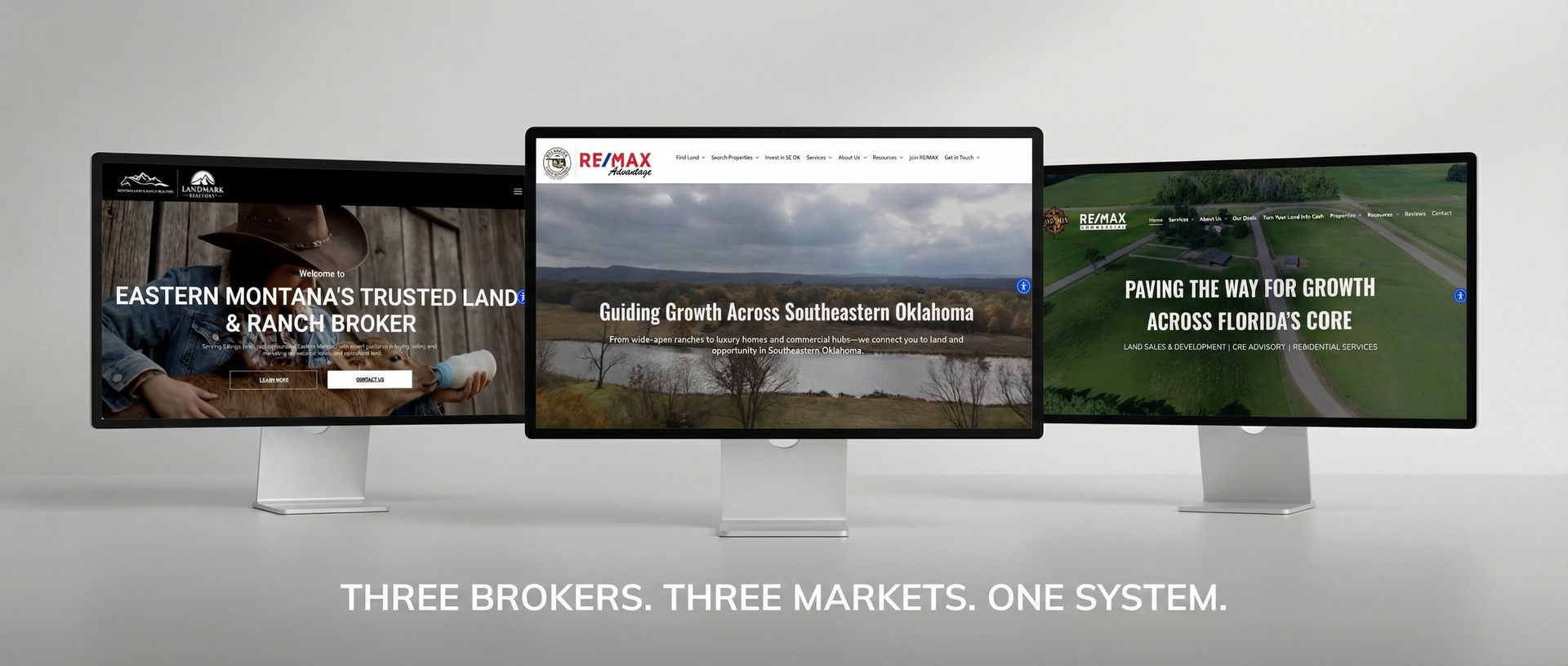
What happens when you apply the same complete marketing infrastructure to brokerages in Montana, Oklahoma, and Florida? Here's what we learned. A website isn't a marketing strategy. It's one piece of infrastructure. And for most land brokers, it's the only piece they have. That's the problem. Over the past year, we built complete marketing ecosystems for three land brokers in three very different markets. Same system. Different execution. All converting. This isn't theory. These are live sites you can visit right now: Erik Erickson — Montana Land and Ranch ( mtlandandranch.com ) Rod Canterbury, ALC — Oklahoma Land Division ( oklahomalanddivision.com ) David Bryant, CCIM — The Land Man ( thelandman.co ) Montana. Oklahoma. Florida. Different landscapes. Different clientele. Different regulatory environments. But the same underlying infrastructure that turns a website into a lead-generating machine. Here's what we built for each — and why it works. The Foundation: What Every Land Broker Actually Needs Before we dive into specifics, let's establish what "complete marketing infrastructure" actually means. It's not a checklist of nice-to-haves. It's an integrated system where each piece supports the others. The seven components: Authority Positioning — E-books, guides, published content that establishes expertise before the first conversation Visual Credibility — Professional video that builds trust faster than text ever could Lead Capture Ecosystem — Multiple entry points for prospects at different stages of readiness Service Architecture — Clear, organized presentation of what you offer and who you serve Resource Value — Tools and information that make your website worth bookmarking Content Engine — Blog, social, YouTube presence that compounds visibility over time Brand Consistency — Unified visual identity across every touchpoint When these seven elements work together, your marketing compounds. Each piece feeds the others. Visitors become leads. Leads become clients. Clients become referral sources. Now let's see how this played out across three different brokerages. Erik Erickson: Montana Land and Ranch The Broker: Erik is a rancher, veteran, and land broker based in Joliet, Montana — just outside Billings. He serves Eastern Montana, helping buyers and sellers navigate ranch land, recreational property, and agricultural transactions. The Challenge: Erik had deep local expertise and a genuine connection to the land he sells. But his online presence didn't reflect that. He needed a platform that communicated his credibility to buyers who might be researching from anywhere in the country. What We Built: Homepage Video: A cinematic brand piece showing the Big Sky country Erik serves. Within three seconds of landing on the site, visitors see sweeping Montana landscapes and understand this isn't a part-time hobby — it's a legacy. Dual E-Book Lead Magnets: "The No B.S. Guide to Buying Land in Montana" — for buyers doing their research "The Legacy Seller's Guide" — for landowners considering selling property that's been in their family for generations Both are available on Amazon (establishing credibility) and as free downloads on the website (capturing leads). The psychology is simple: give away genuine expertise, build trust before the call, and let the content pre-sell your services. Resource Hub: This is where the site becomes indispensable. Erik's resources section includes: GIS maps and property boundary tools Montana hunting access and landowner programs Water rights query systems (critical for ranch land) Mineral rights and geologic data 1031 exchange resources and tools These aren't random links. They're the exact tools that serious land buyers and ranchers use repeatedly. Every return visit reinforces Erik's brand. Every bookmark is a future client. Blog Content: Articles like "Why You Shouldn't Trust Just Any Real Estate Agent with Ranch Land" and "What You Need to Know Before Drilling a Well in Montana" demonstrate expertise while capturing long-tail search traffic. YouTube Presence: @BillingsMTRealEstate features property tours, market insights, and Montana lifestyle content — building a searchable library of credibility. Rod Canterbury: Oklahoma Land Division The Broker: Rod is a lifelong rancher with an ALC (Accredited Land Consultant) designation — an elite credential held by roughly 1,200 professionals worldwide. He's backed by the RE/MAX network and serves Southeastern Oklahoma from his base in Eufaula. The Challenge: Rod had the credentials and the network, but his digital presence wasn't capturing the full scope of what he offered. He needed a platform that could attract everyone from local landowners to out-of-state investors to commercial developers. What We Built: Homepage Video: Rod's video communicates two things simultaneously: deep local roots (he's a lifelong rancher who knows this land) and global reach (RE/MAX network, international connections). That combination is rare, and the video makes it tangible within seconds. Triple E-Book Strategy: "Legacy to Liquidity" — for landowners ready to convert family land into cash "Oklahoma Dirt" — a comprehensive guide to land investment in the state "Oklahoma's Data Center Opportunity" — a white paper positioning Southeastern Oklahoma as the next frontier for data center development (this attracts an entirely different buyer profile) The data center white paper is worth noting. It's not a generic guide — it's a strategic piece of content designed to attract commercial developers and position Rod as the expert in a specific emerging opportunity. That's targeted authority positioning. Resource Hub: Oklahoma-specific tools including: Oklahoma Land Access Program links State business incentives and relocation resources New Markets Tax Credit information Wildlife Conservation department resources Multi-Platform Lead Capture: The site includes distinct pathways for: Farm & ranch sellers Recreational land buyers Commercial developers International investors Off-market deal seekers Each pathway captures different information and triggers different follow-up sequences. A recreational buyer and a commercial developer have nothing in common except that they both might contact Rod — so why would you put them through the same form? YouTube Presence: @oklahomalandforsale provides land investment education and property features, building searchable content that works 24/7. David Bryant: The Land Man (Central Florida) The Broker: David holds the CCIM designation (Certified Commercial Investment Member) and serves Central Florida's I-4 corridor — Marion, Sumter, Polk, and Lake Counties. This is one of the fastest-growing regions in the country, and David specializes in development sites, commercial properties, and land sales. The Challenge: David's market is different from Montana or Oklahoma. Central Florida is experiencing explosive growth, attracting developers, investors, and corporations from across the country and internationally. He needed a platform that could speak to sophisticated commercial buyers while also serving local landowners. What We Built: Homepage Video: David's video positions him as THE land authority in Central Florida. The messaging is clear: if you're looking to buy, sell, or develop land in this region, this is who you call. Strategic Lead Magnets: "The Land Man's Guide to Buying, Selling & Maximizing Your Land's Potential" — comprehensive e-book for landowners "2026 Central Florida Market Outlook Report" — data-driven market analysis for investors and developers The market outlook report deserves attention. It's not a sales piece — it's genuinely useful market intelligence that positions David as the expert who understands where this market is heading. Developers and investors download this because they need the data. And now David has their contact information and has established his expertise before any conversation. Resource Hub: Florida-specific tools including: Greenbelt agricultural tax assessment guides (county by county) EQIP and Conservation Reserve Program information Delaware Statutory Trust (DST) resources for 1031 exchanges Preferred lender directory EB-5 investor program information (for international buyers) The EB-5 information is strategic. Central Florida attracts significant international investment, and having resources for foreign buyers signals that David operates at that level. Service Architecture: Clear separation between: Commercial brokerage services Land sales and development Residential services Property management Each service has its own pathway, its own messaging, and its own lead capture. A developer looking for a 50-acre site and a family looking for a home with acreage are both served — but through different doors. The Pattern: What All Three Have in Common Different states. Different markets. Different broker personalities. But the same underlying infrastructure: Component Montana Oklahoma Florida Homepage Video ✓ ✓ ✓ E-Book Lead Magnets 2 guides 3 guides + white paper 2 guides + market report Resource Hub GIS, water rights, hunting, minerals Land access, incentives, wildlife Tax assessment, DSTs, EB-5 Multiple Lead Capture Points ✓ ✓ ✓ YouTube Presence ✓ ✓ ✓ Blog Content Strategy ✓ ✓ ✓ Consistent Brand Identity ✓ ✓ ✓ The specific content is different because each market is different. But the system is the same. And here's what matters: a system can be repeated. Why This Approach Works 1. Authority is established before the phone rings. By the time someone calls Erik, Rod, or David, they've likely downloaded an e-book, watched a video, and explored the resources. They're not calling to evaluate — they're calling because they've already decided this is the expert they want to work with. 2. Multiple entry points capture prospects at every stage. A landowner who's three years away from selling isn't going to fill out a consultation request. But they might download "The Legacy Seller's Guide." Now they're in the ecosystem, receiving value, building familiarity. When they're ready, there's no question who they'll call. 3. Resource hubs create return visits. A one-time website visit is forgettable. But when your site has the water rights lookup tool someone uses monthly, or the rainfall maps a rancher checks weekly, you become part of their workflow. That's how you become the default choice. 4. Video builds trust faster than text. Three seconds of video communicates more credibility than three paragraphs of text. When someone sees Erik on his ranch, Rod with his cattle, David in front of development sites — they understand immediately that these are real operators, not just salespeople. 5. Content compounds over time. Every blog post, every YouTube video, every resource page is working 24/7. A blog post about well permits in Montana might generate leads for years. That's infrastructure, not just marketing. What This Means for Other Land Brokers One case study is a project. Three case studies is a system. If you're a land broker looking at your current online presence and feeling like it doesn't reflect your actual expertise and capabilities — you're probably right. The question isn't whether this approach works. We've now proven it works across three different states, three different market conditions, and three different broker profiles. The question is what YOUR version looks like. What's the landscape you serve? What's the expertise you've accumulated that buyers would pay for? What resources do your clients use repeatedly that could live on your site? The infrastructure is the same. The execution is yours. Montana. Oklahoma. Florida. Three brokers who decided their online presence should match their real-world expertise. See for yourself: mtlandandranch.com oklahomalanddivision.com thelandman.co
January 7, 2026
Talk to ten land brokers about their technology and you'll get ten different answers. Some are using tools from 2015. Others are chasing every new app that launches. Most are somewhere in between—cobbling together solutions that kind of work but don't really talk to each other.  We've spent the past year watching what top performers actually use. Not what they say they use. Not what they tried once. What's actually running their business day to day. Here's what we found. The Core Problem: Land Is Different Most real estate technology is built for residential agents. High volume. Fast transactions. Lots of similar properties. Land doesn't work that way. Transactions are slower. Properties are unique. Data is scarce. The tools built for selling houses often fail when applied to selling acreage. The brokers who thrive have figured out which mainstream tools work for land—and where they need land-specific solutions. CRM: Keep It Simple The most common mistake: buying a CRM that's too complicated. Yes, Salesforce can do everything. No, you don't need it. The brokers we talked to who actually use their CRM consistently tend to favor simpler tools. Follow Up Boss, Pipedrive, even well-organized spreadsheets. What matters isn't features. It's whether you'll actually use it every day. A simple system you maintain beats a powerful system you abandon. The key functions: capture every lead, track every interaction, schedule follow-ups, and segment by buyer type and timeline. That's it. Everything else is nice to have. Mapping and Research: The Land-Specific Layer This is where generic real estate tools fall short. Land brokers need to understand parcels in ways residential agents don't. Topography, soil types, flood zones, timber coverage, neighboring uses. You can't get that from Zillow. The tools that work: onX for property boundaries and terrain, USDA Web Soil Survey for soil data, FEMA flood maps, county GIS systems for ownership and tax info. Google Earth Pro for historical imagery and measurement tools. Some brokers subscribe to paid platforms like LandGlide or AcreValue for consolidated data. Others piece together free resources. Either approach works—what matters is having a reliable research workflow. AI: The Multiplier A year ago, AI was a curiosity. Now it's a competitive necessity. The brokers pulling ahead are using AI for research summaries, property descriptions, email drafts, social content, and market analysis. Not as a replacement for expertise—as an accelerator. The key insight: AI is only as good as your prompts. Brokers who've built libraries of effective prompts—customized for their voice and their work—get dramatically better outputs than those who type generic requests. Tools vary. Some use ChatGPT directly. Some use Claude. Some use specialized platforms built for real estate. The tool matters less than developing the skill to use it effectively. Social Media: Scheduling Is Non-Negotiable The brokers with consistent social presence all have one thing in common: they don't post manually every day. They batch content. They schedule ahead. They use tools like Later, Buffer, or Meta Business Suite to queue up posts and forget about them. This isn't about removing the human element—it's about removing the friction. When posting requires logging in, finding an image, writing copy, and hitting publish, it doesn't happen consistently. When it's already scheduled, it just happens. Some brokers create content themselves and schedule it. Others use done-for-you services. The common thread is that daily posting doesn't depend on daily effort. Photography and Video: Quality Matters More Than Equipment Drone footage has become standard for land marketing. Most brokers either fly themselves (Part 107 certified) or have a reliable vendor they use. The surprise: smartphone cameras have gotten good enough that professional photography isn't always necessary. The iPhone 15 Pro shoots better video than professional cameras from five years ago. What matters more than equipment is showing up at the right time (golden hour), capturing the right angles, and telling a visual story. That said, the brokers with the best marketing tend to invest in professional photography for significant listings. The cost is minimal relative to commission, and the quality difference is noticeable. Document Management: Cloud-Based and Searchable Physical files are dead. Every broker we talked to has moved to cloud-based document management. Google Drive and Dropbox are the most common. Some use real estate-specific platforms. The key features: easy upload from mobile, searchable file names, and organized folder structures. The brokers who've systematized this can find any document from any deal in seconds. The ones who haven't are still digging through email attachments. Transaction Management: Integration Over Features dotloop, SkySlope, DocuSign—the specific platform matters less than whether it integrates with everything else. The worst scenario: a transaction management system that creates its own silo. You're entering information twice, exporting and importing, manually syncing data. The best scenario: tools that talk to each other. When a contract is signed, the CRM updates automatically. When a closing date changes, calendar invites adjust. When the deal closes, records archive properly. This level of integration often requires some initial setup—but it saves hours on every transaction afterward. The Stack That Works If we had to recommend a starting point for a land broker building their tech stack today: CRM: Follow Up Boss or Pipedrive—simple, mobile-friendly, actually usable. Research: County GIS + onX + Google Earth Pro—covers most needs for free or cheap. AI: ChatGPT Plus or Claude—with a personal library of prompts built over time. Social: Later or Buffer—schedule once a week, post all week. Documents: Google Drive—free, searchable, accessible everywhere. Transaction: Whatever integrates with your brokerage—don't fight the system. That's a functional, affordable stack that handles 90% of what a land broker needs. Start there. Add specialized tools as specific needs arise. Technology Serves the Work The brokers who succeed with technology are the ones who remember it's a tool, not the point. The point is still relationships. The point is still expertise. The point is still showing up for clients and delivering results. Technology should make that easier. If it's making it harder—if you're spending more time managing tools than using them—something's wrong. Build a stack that serves your work. Then get back to work. Landverse AI brings together the tools land brokers actually need—research, content creation, marketing systems—in one platform built for how you work. See what's possible at landverseai.com .
January 7, 2026
The listing appointment isn't where you win the listing. It's where you confirm what the seller already believes. If you show up as a stranger and try to sell yourself, you're fighting uphill. But if you show up as the broker they've already researched, already trust, and already expect to hire—the appointment is a formality. Here's how to win before you walk in. The Seller Has Already Decided (They Just Don't Know It Yet) By the time a seller invites you for a listing appointment, they've already formed an opinion. They've looked at your website. They've scrolled your social media. They've Googled your name. They've asked around. Most of that happened before they ever called you. The brokers who win consistently aren't the best presenters. They're the ones who've done the work to shape that opinion before the meeting. By the time they walk in, the seller already feels like they know them, trust them, and want to work with them. That doesn't happen by accident. It happens through deliberate preparation—both long-term positioning and deal-specific research. Long-Term Positioning: The Work You Do Every Day Winning listing appointments starts months before any specific opportunity arises. Your online presence matters. When a seller Googles you, what do they find? A professional website that shows you understand land? Social media that demonstrates your expertise? Content that answers their questions before they ask? Or do they find nothing—a broker who doesn't appear to exist online? Every piece of content you create, every post you publish, every testimonial you collect—it's all building the impression sellers form before they meet you. The broker with a strong online presence walks into appointments with credibility already established. Your reputation precedes you. In land markets, everyone knows everyone. Past clients talk. Other brokers talk. When a seller asks around, what do they hear? Deliver great service on every deal. Communicate consistently. Follow through on what you promise. The seller who calls you because three people recommended you is already 80% sold. Deal-Specific Prep: The Work You Do Before This Appointment Long-term positioning gets you the meeting. Pre-appointment research wins it. Know the property. Before you walk in, you should know that parcel better than the seller expects. Pull the tax records. Review the title history. Check the zoning. Look at aerial imagery. Drive by if possible. Identify comparable sales. When you can say "I noticed the easement along the northern boundary—let me tell you why that won't be an issue for most buyers," you've demonstrated expertise they weren't expecting. Know the market. What's selling in this area? At what prices? How long is it taking? What's the buyer demand for this type of property? Sellers want to know their land will sell. Showing up with market data—not generic, but specific to their property type and location—proves you've done your homework. Know the seller. If possible, learn something about who you're meeting. Have they owned this land for decades? Is it a family property? Are they selling for financial reasons or lifestyle changes? Understanding motivation helps you frame everything you say. A seller who inherited land they've never visited needs a different approach than one who's selling the ranch they built from scratch. The Pre-Appointment Package Top brokers don't just show up and talk. They send something ahead of time. A pre-appointment package might include: a brief introduction to you and your approach, relevant comparable sales, a market overview for the property type, testimonials from similar sellers, and an outline of what you'll cover in the meeting. This does several things. It demonstrates professionalism. It gives the seller something to review, which gets them engaged before you arrive. It positions the appointment as a consultation, not a sales pitch. The seller who's already read your materials walks into the meeting predisposed to work with you. The First Five Minutes When you actually walk in, the first five minutes set the tone. Don't launch into your presentation. Start by asking questions. What are their goals? What's their timeline? What concerns do they have? What do they want to know about the process? Listening first does two things. It gives you information you need to tailor your approach. And it signals that you're there to serve them, not to perform. The brokers who talk the most in listing appointments are usually the ones who lose them. The brokers who listen, then respond with insight, are the ones who win. Handling the Competition You're probably not the only broker they're meeting. How do you differentiate? Not by criticizing competitors. Not by having the slickest presentation. Not by promising the highest price. You differentiate by demonstrating that you've already done the work. Your research on their property. Your knowledge of the market. Your preparation. Your materials. When a seller meets three brokers and one of them clearly came prepared while the others winged it—that's not a close call. Preparation is the differentiator. The Follow-Up That Seals It After the appointment, send a follow-up within 24 hours. Thank them for their time. Summarize what you discussed. Outline the next steps if they choose to move forward. Many brokers don't do this. Doing it well—promptly, professionally, personally—reinforces everything you demonstrated in the meeting. The seller is comparing you to everyone else. Make sure your follow-up is better than theirs. The Appointment Is Confirmation When you've done the positioning work, the research work, and the preparation work—the listing appointment feels different. You're not selling. You're confirming. The seller already wants to work with you. They're just looking for reasons to feel good about the decision they've already made. Give them those reasons. Win before you walk in. Landverse AI Academy includes listing presentation templates, pre-appointment checklists, and market analysis workflows to help you win more listings. Stop leaving appointments to chance. Learn more at landverseai.com/academy .