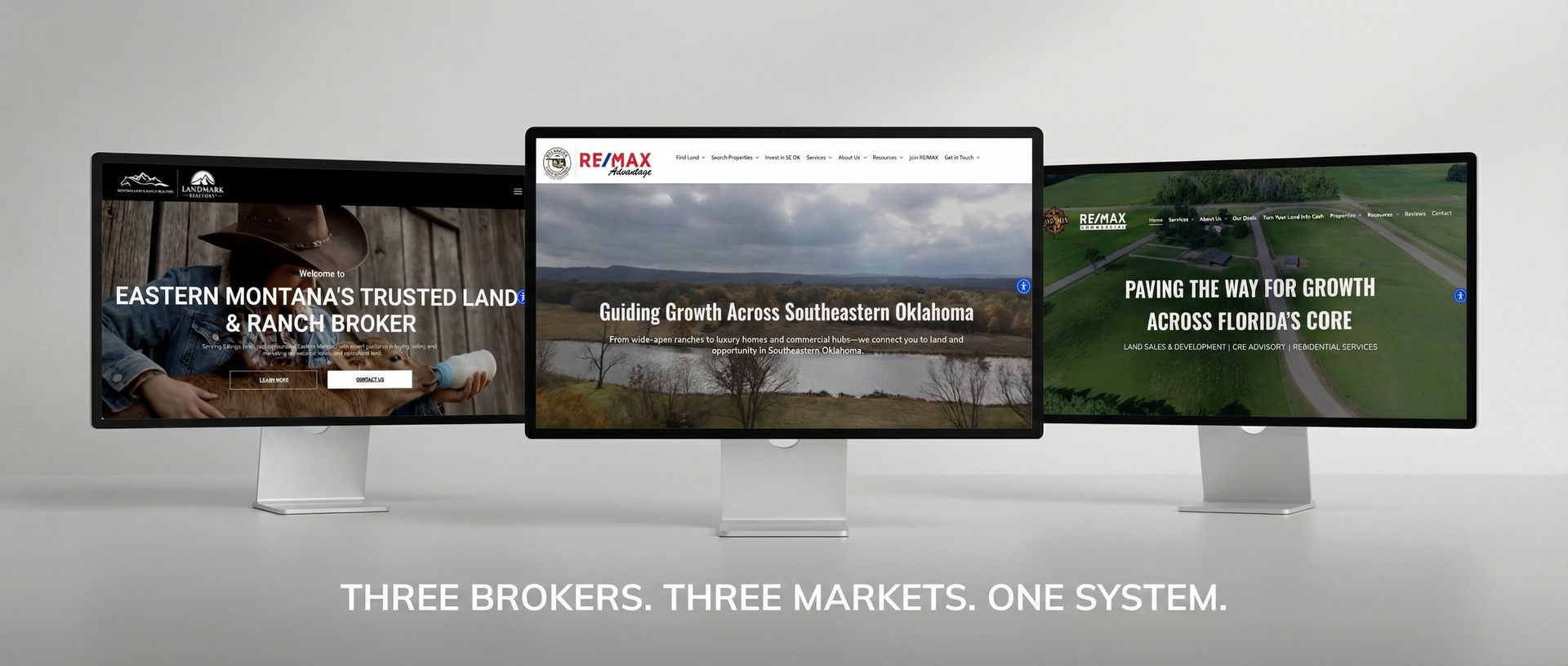

You paid for a website. You've got your listings on it. Maybe you even have a contact form. So why isn't it generating leads?
Here's the uncomfortable truth: most land broker websites aren't built to convert. They're built to exist. There's a difference.
The "Brochure Website" Problem
Most broker websites are digital brochures. They say who you are, show some listings, and hope someone calls. That worked in 2010. It doesn't work now. Today's buyers and sellers do research before they ever reach out. They're comparing you to other brokers. They're looking for signals that you know what you're doing. A static page with your headshot and a list of current properties doesn't give them that.
Worse, most land broker websites are generic. They use the same templates as residential agents. They don't speak to the specific concerns of someone buying or selling land—things like access, water rights, zoning, or how to price rural acreage.
What Actually Converts
Websites that generate leads have three things in common.
First, they establish expertise immediately. Not with claims like "trusted land professional" but with proof. Market reports. Educational content. Answers to the questions buyers and sellers actually have. When someone lands on your site and sees a blog post titled "How to Price Land When There Are No Comps"—they know you understand their problem.
Second, they have clear paths. A confused visitor doesn't become a lead. They leave. Your website needs to guide people: Are you buying or selling? What type of land? What's your timeline? Each click should feel like progress, not a maze.
Third, they give before they ask. Nobody wants to fill out a contact form to "learn more." But they will trade their email for a property valuation checklist, a market report for their county, or a guide to the due diligence process. Value first, contact info second.
The Hidden Traffic Problem
Even a well-built website won't generate leads if nobody sees it. And here's where most land brokers completely miss the mark.
Your website doesn't exist in isolation. It's part of a system. People find you through Google searches, social media, referrals, or your listings on other platforms. Each of those channels should drive traffic back to your site—and your site should be ready to capture it.
That means your social media posts should link to your content. Your listing descriptions should mention your website. Your email signature should include it. Every touchpoint is a chance to bring someone into your ecosystem.
Without that system, your website is a billboard in the desert. It might look nice, but nobody's driving by.
What To Fix First
If your website isn't generating leads, start here:
Look at your homepage as a stranger. Does it immediately tell you what kind of land broker you are and who you serve? Is there a clear next step? Is there a reason to come back—or is it just listings that will be gone next month?
Add one piece of genuinely useful content. A guide, a checklist, a market report. Something that positions you as the expert and gives visitors a reason to trust you.
Then connect the dots. Make sure every social post, every listing, every email has a path back to your site. That's the system. That's what actually generates calls.
Your Website Is Either Working For You Or It Isn't
A website that sits there looking pretty isn't an asset. It's an expense. The land brokers who are winning right now have sites that work—that educate, that capture, that convert.
The good news: this is fixable. And it doesn't require a complete rebuild. Sometimes it just takes clarity, content, and a system that ties it all together.
Landverse AI builds websites specifically for land brokers—designed to convert, not just exist. See examples and learn how it works at landverseai.com/websites.